Most artist shelves are built from runs: a creator joins a title, stays four years, leaves. Jack Kirby's shelf is built from beginnings. Of the omnibus in our catalogue carrying his art, almost every one is a Volume 1 — because he was the artist who started the thing, not the one who took it over.
That makes his catalogue unusual to buy. You are not assembling one long story. You are choosing which foundation you want on the shelf.
How to recognise a Kirby page
If you have never deliberately looked at his work, four things give it away instantly, and they are the reason artists still copy him sixty years later.
Foreshortening as violence. A Kirby fist comes at you out of the panel, enormous, with the arm compressed behind it. He treats the picture plane as something characters can break through rather than pose inside.
The energy dots. Fans named it Kirby Krackle: fields of irregular black circles used for cosmic power, portals and explosions instead of conventional rays. Once you see it you cannot unsee it, and it is everywhere in the cosmic books.
Machinery that means nothing and works anyway. His technology is dense panelled surfaces, dials and cabling with no functional logic, drawn with total conviction. It is why his sci-fi still reads as strange rather than dated.
Monumental bodies. Blocky fingers, slab shoulders, figures built like architecture. Nobody in a Kirby comic is delicate, including the civilians.
The foundation volumes
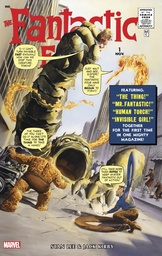
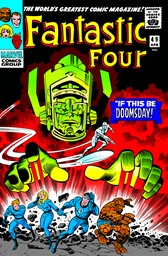
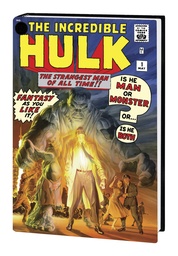
The bulk of the shelf is the 1960s Marvel that he co-created with Stan Lee: Fantastic Four, Thor, The Avengers, Captain America, The Incredible Hulk and The Invincible Iron Man. These are the volumes where the modern superhero universe is being invented in real time, month by month, by people who did not know it would last. The other side of that partnership has its own Stan Lee guide, which is mostly about telling apart the books where his credit means authorship from the ones where it means a few reprinted pages.
Two are worth naming on their own: Captain America Omnibus Vol. 1 and The Invincible Iron Man Omnibus Vol. 1. Availability on this shelf moves constantly, so the reliable place to check is the Jack Kirby page, which puts whatever is available first.
Where he was the whole author
The more interesting half of the shelf is the work where Kirby wrote as well as drew, and where nobody was smoothing him out.
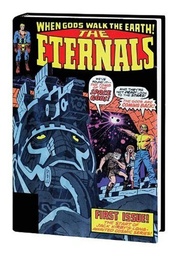
Eternals: The Complete Saga Omnibus is the clearest example: gods, giant celestial machines and deep time, conceived and executed by one person. It is strange in a way collaborative Marvel never quite is.
The Black Panther material sits here too. Kirby co-created the character in the sixties, and the catalogue carries both Black Panther: The Early Marvel Years Omnibus Vol. 1 at 912 pages and Black Panther: Panther's Prey Omnibus at 1,272 pages — the two heaviest books on his shelf by a wide margin.
The DC years
In 1970 Kirby left Marvel for DC, and the work he did there is the other half of the shelf where he was the whole author — writing, drawing and editing himself.
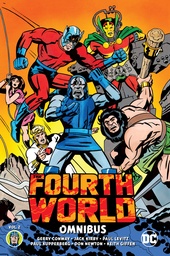
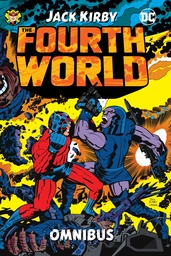
Fourth World by Jack Kirby Omnibus is the big one: 1,536 pages gathering New Gods, Mister Miracle, The Forever People, his run on Jimmy Olsen and the concluding Hunger Dogs. Four series designed to interlock into a single story about warring gods and free will, and the book where Darkseid enters the DC universe.
Kamandi by Jack Kirby Omnibus is the longest solo run of his career: forty issues of a boy crossing a post-apocalyptic America ruled by intelligent animals, with a new society or species invented every few issues.
Back at Marvel afterwards, Devil Dinosaur by Jack Kirby Omnibus is the short, strange coda: nine issues about a red tyrannosaur and a proto-human boy, played entirely straight.
If the Marvel foundation volumes are Kirby inventing a universe with a collaborator, these are Kirby with nobody in the room. Which of the two you prefer is the real question about his shelf.
Where to start
One recommendation: Eternals: The Complete Saga Omnibus. It is self-contained, it needs no continuity, and it is the purest dose of what makes him worth collecting — he is doing the writing and the drawing, so nothing is diluted. If you like it, the 1960s foundation volumes will make sense to you. If you find it airless, they will not.
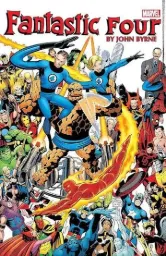
If you specifically want the historical origin rather than the art, start with Fantastic Four Omnibus Vol. 1 instead and read forward. That is where the whole thing begins.
Who should skip this shelf
Sixties Marvel does not read like modern comics and pretending otherwise sets buyers up for disappointment. Plots resolve in one or two issues, dialogue explains what the art already shows, and characterisation is broad. If what you value is slow-burn character work and naturalistic dialogue, Kirby will feel loud and fast in a way you may not enjoy. His reputation rests on invention and draughtsmanship, not on interiority — and that is a legitimate reason to buy something else.










Comments
No comments yet. Be the first to share your thoughts.