Every era gets one artist whose version of Batman becomes the default in readers' heads. For the 1970s it was Neal Adams, for the 2010s it was Greg Capullo. For the 2020s it is Jorge Jiménez, and the unusual part is that he got there across three different writers rather than inside one celebrated run.
If you started buying Batman comics in the last few years, this shelf is what you already think the character looks like.
How to recognise a Jiménez page
Motion drawn as motion. His figures are almost never at rest. Capes, hair and coats trail behind the movement they are recovering from, so a static panel still reads as the middle of something.
Heavy blacks against bright colour. He builds shadow in large solid masses and then lets the colouring go saturated around them. It is why his Gotham looks like night without looking muddy, and it is the clearest break from the desaturated house style of the previous decade.
Faces that overact, on purpose. There is a visible manga influence in how far he pushes expression, particularly on villains. It gives the books a heightened, operatic quality that suits Batman and would be wrong on almost anyone else.
Architecture with weight. He draws Gotham as a real city with buildings that could hold the people in them, and he uses that scale to make Batman look small when the story needs it.
The main run
Batman by James Tynion IV Omnibus Vol. 1-2 at 2,040 pages collects the run as a set, which is exactly the sum of the two individual volumes at 1,040 and 1,000 pages.
This is where the partnership matters most. The writing is covered in the James Tynion IV guide; what Jiménez supplies is a Gotham that feels genuinely dangerous and a Batman who moves like someone who has been doing this for years and is tired. The Joker material in particular works because of how far the drawing is willing to go.
On a single-copy catalogue the set is the safer purchase: assembling the two halves separately over months frequently stalls, and this is one continuous story.
The other Batman runs
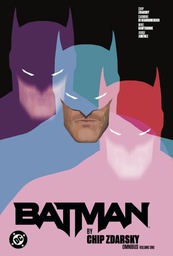
Batman by Chip Zdarsky Omnibus Vol. 1 at 744 pages continues immediately afterwards, with the same artist and a different writer, which makes it an unusually clean way to see what a script changes and what it does not. The writing side is in the Chip Zdarsky guide.
Batman by Tom King Omnibus Vol. 2 at 800 pages holds his earlier Batman pages, drawn inside the very different register described in the Tom King guide.
Before Gotham
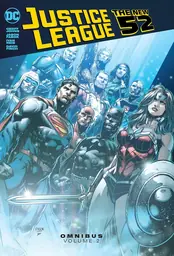
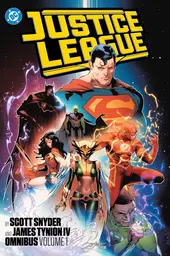
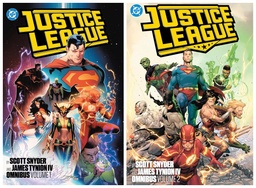
Justice League by Snyder & Tynion Omnibus Vol. 2 at 896 pages is where he worked at cosmic scale before settling into Batman, and it is the best demonstration that the style holds up when the subject is not a man on a rooftop.
What can be bought at any given moment changes; the Jorge Jiménez page shows the shelf with those titles first. The wider DC catalogue lives on the DC omnibus page.
Where to start
One recommendation: Batman by James Tynion IV Omnibus Vol. 1-2. It is the longest sustained stretch of his work, it is a complete story, and it is the run that made him the defining Batman artist of the decade.
If that is too large a first purchase, Batman by Chip Zdarsky Vol. 1 at 744 pages is newer, shorter and needs no previous reading.
Who should skip this shelf
His work is stylised and it commits to that. Expressions are pushed, poses are dramatic, and readers who prefer restraint or photo-realistic grounding will find it too much, particularly on villains. The shelf is also narrow: it is essentially modern Batman, so if you are looking for range or for an artist to follow across genres, there is not much here beyond Gotham.


Comments
No comments yet. Be the first to share your thoughts.