Almost every omnibus in this catalogue that carries Mark Bagley's art is a Spider-Man book. That concentration is the first thing to understand about this shelf: it is not a career survey across the industry, it is essentially one artist drawing one character across three decades, in three separate eras, for three different generations of reader.
What his art actually does
Bagley is not the artist people put on posters, and the reasons for that are the same reasons he is worth collecting.
Legibility above everything. You never lose track of who is where in a Bagley fight. Bodies stay whole inside the panel, the eye moves where he wants it to, and action reads at speed without you having to reconstruct it. That sounds like a low bar until you read a comic that fails at it.
Faces that carry the scene. His teenagers in particular look like teenagers — awkward, mobile, embarrassed. A lot of the emotional work in Ultimate Spider-Man happens in reaction shots that a flashier artist would have skipped.
Consistency at volume. His defining achievement is not a single image, it is a very long unbroken run drawn at monthly pace without the quality sagging. That is an unglamorous skill and an extremely rare one.
No wasted rendering. Clean lines, open compositions, very little hatching. His pages have fewer marks than most, which is why they still read cleanly at omnibus size.
The three eras
The nineties, with David Michelinie. This is Bagley drawing the mainstream Spider-Man of the era, two omnibus of it, plus the Venom material and the Clone Saga. It is where his style hardens into the version everyone recognises.
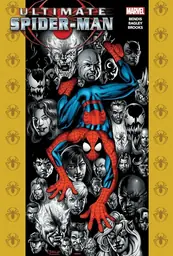
Ultimate Spider-Man, with Brian Michael Bendis. The centre of the shelf and the work that made his reputation: a ground-up retelling of Peter Parker drawn month after month for years. We reviewed the first volume separately in our Ultimate Spider-Man Omnibus Vol. 1 review, which is the best place to look if you only want to judge one book.
Everything after. The later Spider-Man material and, off to one side, Guardians of the Galaxy by Brian Michael Bendis Omnibus Vol. 1 at 1,152 pages — the one book on this shelf that has nothing to do with Spider-Man.
What is available right now
One worth naming on its own is Spider-Man: Clone Saga Omnibus Vol. 2 at 1,288 pages. Stock on a single-copy catalogue moves daily, so the Mark Bagley page is the place to check rather than this article.
Where to start
One recommendation: Ultimate Spider-Man Omnibus Vol. 1. It needs no prior reading at all — that is the entire premise of the Ultimate line — and it is the clearest demonstration of what Bagley is for. If the storytelling there does not win you over, the nineties material will not either.
If you already know Ultimate Spider-Man and want the other end of his range, take the Clone Saga volumes, with the warning that you are buying them for the art and the era, not for a tidy plot.
Who should skip this shelf
If you collect for spectacle — double-page splashes, heavy rendering, cover-grade images on every page — Bagley's virtues are close to invisible. His work is built to be read, not paused over, and the things he does best are the ones you only notice when they are missing. Buy him if you want comics that flow. Buy someone else if you want comics that stop you.






Comments
No comments yet. Be the first to share your thoughts.