John Romita Jr. had the worst possible start available to a Marvel artist: his father drew Spider-Man, defined how the character looked for a generation, and was still working in the building. The interesting thing about his shelf is that it is a forty-year record of a draughtsman refusing the obvious move, which would have been to draw like his dad and coast.
How to recognise a Romita Jr. page
Angles instead of curves. Where his father drew smooth, rounded, classical figures, he builds bodies out of planes and wedges. Jaws are slabs, shoulders are boxes, fists arrive as blunt geometry. It is the most immediately identifiable thing about his work and the deliberate opposite of his inheritance.
Weight and impact. His characters land hard. He draws the moment of contact and the recoil rather than the graceful arc, so his fights feel heavy in a way that slicker artists never manage.
Cities with texture. Rain, brick, fire escapes, wet asphalt. His urban backgrounds are worked rather than implied, and that grime is a large part of why his Daredevil and Spider-Man read as street-level.
A style that visibly changes. This is the rare artist whose early and late work look like two people. The clean, open eighties pages and the jagged, heavily inked later ones are both his, and the shelf lets you watch the transition happen.
The Spider-Man spine
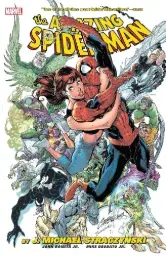
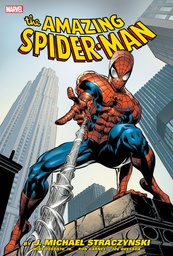
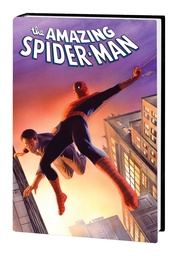
He drew Spider-Man across three separate stretches of his career, decades apart, which almost nobody does. The earliest sits in Amazing Spider-Man Omnibus Vol. 7; the celebrated middle period is Amazing Spider-Man by J. Michael Straczynski Omnibus Vol. 1 and the Spider-Man by Roger Stern Omnibus; the later work runs through the Brand New Day volumes and into Amazing Spider-Man by Zeb Wells Omnibus Vol. 1 and Spider-Man: Gang War Omnibus.
If you want to see the style change, this is the cheapest way to do it: the same character, the same city, three completely different hands. Where these books sit in the wider Spider-Man shelf is covered in our ranked guide to the best Spider-Man omnibus.
The best thing on the shelf
Daredevil by Nocenti & Romita Jr. Omnibus Vol. 1 — 856 pages, continued in Vol. 2 at 992 pages.
This is the run to buy if you want to understand why he matters. Paired with a writer pushing Daredevil into political anger, hallucination and outright strangeness, Romita Jr. produces the most expressive work of his career: distorted, furious pages that no other Marvel book of the period looks like. It is also the run that gets skipped in most Daredevil conversations, which makes it the best value on this shelf.
The X-Men and the rest
Uncanny X-Men Omnibus Vol. 4 and Vol. 5 hold his eighties X-Men work, drawn inside the long Claremont era we map in the Chris Claremont guide, plus X-Men: Mutant Massacre Prelude and the crossover material.
Beyond the big two characters: Black Panther by Reginald Hudlin, Iron Man by Michelinie, Layton & Romita Jr., Captain America by Rick Remender, Avengers vs. X-Men and, the genuine oddity, Dazzler Omnibus at 1,360 pages.
Which of these can be bought at any given moment changes constantly, so the John Romita Jr. page is where to check availability rather than this article.
Where to start
One recommendation: Daredevil by Nocenti & Romita Jr. Vol. 1. It is the most artistically ambitious work of his career, it is self-contained, and it is not the obvious pick, which means the price has never been inflated by reputation the way the Spider-Man volumes have.
If you would rather start with the famous material, take the Straczynski Amazing Spider-Man instead and read it as the moment his mature style locked in.
Who should skip this shelf
His later style is genuinely divisive. The angularity that reads as force and character to some readers reads as stiff and ugly to others, and there is no middle position — you will know within ten pages. If what drew you here was his father's smooth classicism, be warned that the son spent his career doing the opposite on purpose.








Comments
No comments yet. Be the first to share your thoughts.