A handful of omnibus in this catalogue carry Jim Lee's art. That is a small shelf next to Kirby's or Claremont's, and it is still probably the most influential per volume of any artist we stock — because for most of the nineties, "drawing like Jim Lee" was simply what drawing superheroes meant.
The shelf divides on a clean line. Half of it is Marvel at the start of the nineties. Half is DC from the 2000s onward. The gap between them is where he left to help found his own publisher, and you can see what that decade did to his line work.
How to recognise a Jim Lee page
Density of line. He renders with cross-hatching where most artists would leave flat colour: folds inside folds, hatching on jaws and biceps and boots. A Lee page has more marks on it than the pages around it, and that is the first thing your eye registers.
Costume design that sticks. His redesigns tend to become the definitive version. The uniforms he put the X-Men in for the 1991 relaunch outlived the run by decades, which is not a normal outcome for a costume tweak.
Poses built for the poster. Figures are staged frontally, weight distributed for maximum silhouette, often facing the reader rather than each other. It is why his pages read like a sequence of covers — a strength if you want spectacle, a limitation if you want quiet storytelling.
Faces on a house model. Square jaws, heavy brows, hair drawn in defined ribbons. Very consistent, and deliberately so.
The Marvel half
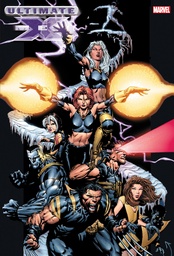
X-Men: Blue & Gold – Mutant Genesis Omnibus is the centre of this shelf at 1,360 pages. It collects the 1991 relaunch, the point where his style stopped being one option and became the template.
The same era is also collected as X-Men by Claremont & Lee Omnibus in two volumes of 777 pages each, approached from the writer's side rather than the artist's — we cover that route in the Chris Claremont guide. X-Men: X-Tinction Agenda (984 pages) sits just before it and shows the style still forming.
The DC half
Batman: The Hush Saga Omnibus (1,272 pages) is the book most people mean when they say they own a Jim Lee comic. It is built as a tour of Batman's world, which suits an artist whose instinct is to give every character a full-page entrance.
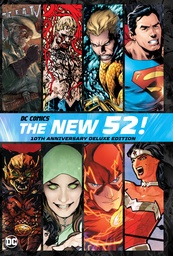
Then the New 52 Justice League: available both as a single volume of 1,248 pages and as a Vol. 1-2 set running to 2,504 pages — the largest single purchase on this shelf. DC New 52 Villains Omnibus (1,184 pages) collects the line-wide event alongside it.
Availability on this shelf is sporadic. The Jim Lee page shows availability first and is the place to check rather than this article.
Where to start
One recommendation: X-Men: Blue & Gold – Mutant Genesis. It is the moment his style arrived fully formed, it is the reason the rest of the shelf exists, and it is the book that explains why the nineties looked the way they did.
If you have no interest in the X-Men and want the best-drawn single story, take Batman: The Hush Saga instead.
Who should skip this shelf
Buy these for the art, because the writing across them is uneven in a way the art is not. The 1991 X-Men material is famously a run where the plotting came apart behind the scenes; the New 52 Justice League is competent event storytelling rather than anything anyone will call a classic. If you judge a comic primarily on script, this shelf will disappoint you at least twice. If you buy pages you want to look at, it will not.









Comments
No comments yet. Be the first to share your thoughts.