X-Force is the mutant shelf where the team book stops pretending every problem can be solved by being inspirational in public. The line begins with Cable, weapons, mission language and a harder edge than the classic X-Men. Later, the idea mutates into tactical broken-future stories and Rick Remender's black-ops book about doing terrible things for reasons the characters keep trying to call good.
That means X-Force is not one promise. X-Force Omnibus Vol. 1, Cable & X-Force Omnibus and Uncanny X-Force by Rick Remender Omnibus all belong to the shelf, but they serve different readers.
This guide separates foundation, Cable route and Remender route so the X-Force shelf reads like a progression instead of a pile of aggressive mutant spin-offs.
Start with Uncanny X-Force by Rick Remender if you want the strongest modern first buy. Start with X-Force Vol. 1 if you want the historical Cable-led foundation. Add Cable & X-Force if you want the tactical Cable lane.
The Three X-Force Promises
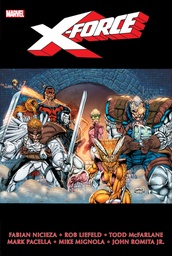
The first promise is impact. The original X-Force shelf is about the New Mutants energy hardening into something more militarized. Odoo source data for X-Force Omnibus Vol. 1 points to X-Force #1-25 and related material, with Cable, Cannonball, Domino, Shatterstar, Warpath, Boom-Boom and Feral, plus Mutant Liberation Front, Stryfe, Legacy Virus tension and Cable clone conflict. That is the foundation: loud, forceful, tied to Cable and built around a team that wants to act before the world asks nicely.
The second promise is tactical continuity. Cable & X-Force Omnibus is described in production data as the militarized high-impact side of mutant comics, with Cable teams organized around urgency, weapons and broken futures. This is not the original launch and not the Remender moral machine. It is the Cable lane: mission pressure, future damage and team politics.
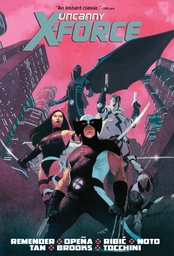
The third promise is moral surgery. Uncanny X-Force by Rick Remender Omnibus is the modern book many readers mean when they say “best X-Force.” Odoo frames it as a black-ops story about the cost of doing terrible things for good reasons, with Wolverine, Psylocke, Deadpool and Fantomex wrapped in Apocalypse mythology, team politics and fallout.
Route 1: The Original Cable-Led Foundation
Choose X-Force Omnibus Vol. 1 first if you want to understand where the name becomes its own thing. This is the book that turns youth-team energy into a more militant identity. Cable is central because he changes the posture of the shelf. The team is not merely learning, reacting or hoping. It is pushing into danger with heavier tools and a harder vocabulary.
This route matters historically even if it is not the smoothest modern first buy. It explains why X-Force feels different from X-Men, X-Factor and New Mutants. The concept has attitude before it has refinement. That attitude is part of the shelf's DNA: force, urgency, weapons, future fear, big personalities and the sense that the mutant world has become too dangerous for polite superhero rhythm.
Buy this route if you care about the original identity, Cable as a franchise engine, or the 1990s mutant shelf. Do not buy it first if what you want is the tightest modern moral thriller. That is Remender's lane.
Route 2: The Cable Tactical Lane
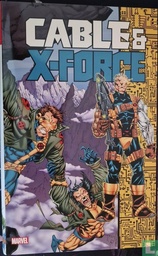
Cable & X-Force Omnibus belongs to the shelf because it keeps Cable at the center of the mission-machine version of X-Force. The production description emphasizes urgency, weapons, broken futures, Fabian Nicieza, Tony Daniel, team politics and fallout. That is a very different promise from “classic team launch.”
This is the best route for readers who specifically like Cable as the organizer of desperate mutant action. It is not the broadest X-Men entry point and not the most famous X-Force recommendation, but it gives the shelf a tactical middle lane: less foundational than Vol. 1, less morally surgical than Uncanny X-Force, but very much about why Cable and X-Force keep orbiting each other.
For buying order, treat Cable & X-Force as an expansion. It makes most sense after you know you like Cable's role in the franchise or after the original X-Force premise has sold you on militarized mutant storytelling.
Route 3: Remender's Black-Ops Reinvention
Uncanny X-Force by Rick Remender Omnibus is the best first purchase for many modern readers because it turns X-Force into a clean, brutal question: what happens when a team decides that some threats must be solved in the dark, and then discovers that darkness does not stay outside the people doing the work?
The cast matters. Wolverine, Psylocke, Deadpool and Fantomex are not a random cool lineup. They create tonal instability: violence, trauma, jokes, performance, guilt and self-justification in the same room. The Apocalypse mythology gives the run scale, but the reason readers remember it is the cost. The book keeps asking whether the team can do awful things without becoming the proof that those things should never have been done.
This is not the historical start, but it is the strongest modern entry because its identity is immediately legible. You do not need to love every 1990s X-Force beat to understand the premise. You need to be interested in a mutant black-ops book where the mission damages the people who claim to control it.
Common Buying Mistakes
The first mistake is buying X-Force Vol. 1 expecting Remender. Original X-Force is the foundation of the name, but it is louder, more Cable-driven and more rooted in the launch identity. It is essential for historical collectors, not automatically the best modern first taste.
The second mistake is buying Uncanny X-Force and then assuming all X-Force reads like that. Remender is a refinement and a reinvention. The earlier shelf explains the word “force”; Remender tests the moral consequences of using it.
The third mistake is skipping Cable & X-Force because it is not the most famous title. If Cable is the reason you are building this shelf, that book matters. If Remender is the only thing you want, it is optional. The right answer depends on whether your X-Force interest is historical, tactical or moral.
Recommended Reading Order
For the best modern route, start with Uncanny X-Force. It is the clearest first purchase and the strongest self-contained argument for why X-Force can be more than an aggressive X-Men branch.
For the historical route, read X-Force Vol. 1 first. Add Cable & X-Force if Cable's tactical, broken-future energy is the part that interests you. Then read Uncanny X-Force as the darker reinvention of the concept.
For the completionist route, collect all three lanes and keep their jobs separate: original foundation, Cable mission shelf, Remender black-ops tragedy. The shelf makes far more sense when those promises are not collapsed into one tone.
Choose Your X-Force Shelf
X-Force changes meaning depending on whether you want foundation, Cable or moral fallout.
Modern black-opsUncanny X-Force
Start here for the strongest modern version: Apocalypse mythology, moral cost and a team damaged by its own mission.
Cable hardens the teamX-Force Vol. 1
Choose this to understand the original forceful identity: Cable, weapons, big personalities and 1990s mutant urgency.
Tactical broken futuresCable & X-Force
Add this when Cable's mission pressure matters more to you than the general X-Force brand.
Wrong expectationDo not expect one tone
Original X-Force, Cable & X-Force and Remender all use the name differently. Buy by promise, not by logo.
Final Route
The best X-Force first buy for most modern readers is Uncanny X-Force by Rick Remender. The best X-Force first buy for historical collectors is X-Force Vol. 1. Cable & X-Force is the expansion for readers who want Cable as the center of mutant tactical pressure. Treat those as three routes, not one ladder. X-Force becomes much clearer when you stop asking which volume is “the” start and start asking what kind of mission you want on the shelf.

Comments
No comments yet. Be the first to share your thoughts.