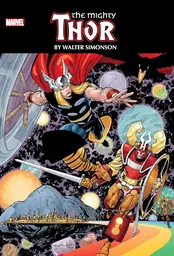
There are a few comics that consistently feature on any serious list of the best works in the American superhero genre. Watchmen. The Dark Knight Returns. Sandman. And also, with less media hype but just as much critical acclaim: Walter Simonson’s Thor. The Mighty Thor by Walter Simonson Omnibus brings together that entire run.
The publishing context
In 1983, Thor was a comic in the midst of an identity crisis. It had been running for over twenty years since its debut in Lee and Kirby’s Journey into Mystery, but recent years had been inconsistent. The grandiloquent Shakespearean tone of the 1960s had eroded, writers came and went without any consistency, and the character had lost prominence within the Marvel catalogue.
Marvel offered Walter Simonson the series as a writer-artist in his own right, with absolute freedom. Simonson was a technically respected veteran but lacked the commercial clout of a Frank Miller or a Byrne at that time. He accepted, and the first thing he did was somewhat unexpected: the first issue of his run ends with Thor losing his hammer, abandoning his identity, and an alien-horse appearing, brandishing Mjölnir.
Beta Ray Bill
Beta Ray Bill is probably the most memorable new character ever introduced in Marvel. The premise was a joke: an alien horse wielding Thor’s hammer. Simonson turned it into a cosmic drama. Bill is the champion of the Korbinites, physically remade by his own people’s scientists into a war machine to guard the fleet carrying the survivors of his world. When he meets Thor, he isn’t seeking to steal his power: he seeks the dignity of proving he is a true warrior.
Bill turns out to be worthy of the hammer. Thor, having lost it, must confront what lies within him beyond the weapon: was it dignity that made him Thor, or the hammer? Odin, following the duel between the two, has the dwarves of Nidavellir forge a second hammer for Bill: Stormbreaker. Since then, Beta Ray Bill has been one of the most beloved characters in the Marvel universe and has headlined his own miniseries decades later.
Surtur and the Ragnarok saga
The second major arc of the run is the arrival of Surtur, the fire giant who threatens to destroy the Nine Realms in Ragnarok. Simonson builds the saga across fourteen issues, from #340 to #353, drawing every page as if it were a showcase: oversized splash pages, sounds visually integrated into the composition, and an epic scale that not even Kirby had achieved in his day.
There are scenes from this saga that serve as reference material in comic art schools: Surtur’s arrival on Earth, the final confrontation with Odin, the issue where Odin falls and Surtur declares the end of the gods. These are pages that have been cited by artists as a direct influence for decades.
Frog Thor
In the midst of the epic, Simonson indulges in a bizarre issue: Thor is transformed into a frog by a spell cast by Loki. During an urban adventure in Central Park, a frog with Thor’s powers battles sewer rats and learns to survive in a world he does not understand.
It seems like an absurd joke. But Simonson turns it into a commentary on identity, pride and the nature of power. And visually, the frog with a helmet and hammer has become one of the most recognisable images in American comics. The anecdote sums up the author well: capable of shifting from cosmic epic to absurd comedy without losing his tone or narrative authority.
Visual experiments
Simonson did things in Thor that few superhero artists had dared to do:
- Onomatopoeia as structural elements: the famous typographic ‘DOOM’ that announces Surtur’s arrival is a sound effect, the blow of his hammer forging the sword Twilight, set so large across the page that it stops being a label and becomes part of the composition. Typography and art merge.
- Issues without dialogue: entire sequences where the narrative is sustained solely by imagery and gestures. Simonson understood that comics do not require continuous text.
- Double-page spreads: splash pages that break the panel structure and become murals. Today it is commonplace; in 1984 it was revolutionary.
What the omnibus contains
The volume collects Simonson’s complete run on Thor: the years as writer-artist, from the arrival of Beta Ray Bill to the aftermath of Ragnarok, plus the issues he went on writing after handing the art to Sal Buscema, and extra editorial material.
In total: 1,192 pages of continuous comic book storytelling by a single creative voice. That consistency is what makes the run so special: at Marvel, it is unusual for a single author to maintain total control over a character for so many consecutive issues.
Honest weaknesses
Simonson’s visual style isn’t for everyone. If you’re coming from modern realistic comics (Jim Lee, Marco Checchetto), Simonson may seem more stylised, with exaggerated anatomies and less refined faces. It’s an 80s aesthetic, with its conventions and limitations.
It’s also a dense comic. You won’t get through it in 20 minutes. The dialogue is lengthy (Thor speaks in a Shakespearean tone almost all the time), the story arcs stretch over dozens of issues, and you need to be patient with the author’s unhurried pace.
Buying verdict
If you have to buy just one Thor omnibus, this is the only one that deserves that priority. If you’ve never read the character before, this is the omnibus that will convince you why it’s worth it. And if you’re already a fan, it’s probably the best version of the character you’ll find in print.
Editor’s note: this is a five-star read, no questions asked. Most of the omnibus volumes we sell are recommended within their niche; this one is recommended as an American comic, without needing to be a fan of Thor or the genre. Essential reading.
View product details
Quick collector answer
Review: The Mighty Thor by Walter Simonson Omnibus is most useful if you want to decide whether this volume really belongs in a Thor in omnibus format collection. The goal is not to replace the review, but to summarize who the omnibus works for, how much continuity it asks from the reader and how to buy it without looking only at the listed price.
Frequently asked questions
Is Review: The Mighty Thor by Walter Simonson Omnibus a good buy in original English omnibus format?
Yes if the subject matches your reading priority. The most important choice is an omnibus you genuinely want to read and keep, not only a popular or hard-to-find volume.
Do you need to know all continuity before reading this kind of omnibus?
Not necessarily. Major US omnibuses mainly ask you to understand the era and tone of the run. A guide or review helps clarify whether the volume is standalone, modern, classic or more connected to other events.
Does reading the original English edition change the experience?
For many collectors, yes. The original English edition preserves dialogue, arc titles and the US format, which keeps the shelf more consistent when comparing multiple Marvel or DC runs.
Why compare European stock with US imports?
Because an omnibus is heavy, expensive to ship and vulnerable to damaged corners. For buyers in France or Europe, delivered price, packing, tracking and returns matter as much as the listed price.
What should you read after this post?
The best next step is usually inside the same reading cluster: a character guide, a related run review or a buying comparison. That builds a logical shelf instead of stacking volumes with no clear order.

Comments
No comments yet. Be the first to share your thoughts.