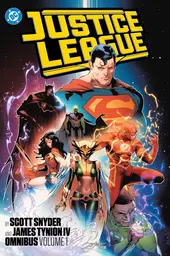
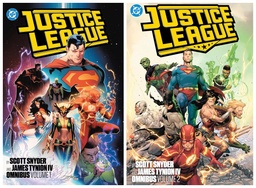
Justice League by Scott Snyder and James Tynion IV Omnibus Vol. 1 is not a calm Justice League book. It is a pressure test. The Source Wall is damaged, the Totality arrives, Lex Luthor builds a Legion of Doom, and the team is pushed into a version of DC where every idea wants to be cosmic, ancient or catastrophic.
That is the appeal and the warning at the same time. This omnibus is exciting if you like modern DC at full volume. It is exhausting if you want a clean, character-first Justice League entry with minimal continuity drag.
A Justice League Omnibus at Full Volume
The book understands the League as the center of the DC line. Batman, Superman, Wonder Woman and the wider team are not solving a small case. They are operating inside a universe that keeps raising the ceiling: hidden forces, old mythology, villain architecture and consequences that feel built for event readers.
That gives the omnibus momentum. It has scale, confidence and a sense that the Justice League matters. When the Legion of Doom energy clicks, the book feels like a bright, loud superhero machine.
The Appeal: Big Villains, Big Lore, Big Stakes
The strongest reason to buy it is the villain structure. Lex Luthor is not simply a recurring antagonist; he becomes the organizer of a counter-League. That creates a clean shelf hook: heroes and villains mirrored at blockbuster size.
Snyder and Tynion also lean into DC lore without embarrassment. If you enjoy cosmic maps, secret histories, impossible artifacts and the feeling that every chapter is opening another door, this omnibus gives you plenty to chew on.
The Cost: Density and Event Gravity
The same scale can become the problem. The book is dense. It carries post-Metal energy, event setup and a lot of proper nouns. Readers coming in cold may feel they are joining a conversation already moving at speed.
That does not make it bad; it makes it specific. This is not the first Justice League omnibus I would hand to someone asking, "Who are these characters and why do they work together?" It is better for someone asking, "How big can modern DC make the League feel?"
Who Will Love This
Buy it if you like cosmic escalation, villain teams, big continuity toys and a Justice League that feels plugged into the entire DC universe. It is also a strong match for readers who came through Dark Nights: Metal and want that energy to continue rather than reset.
Collectors who enjoy shelves organised around eras will understand the place of this volume quickly: this is the post-Metal League as event engine.
Who Should Start Elsewhere
If you want the cleanest first Justice League shelf, start elsewhere. This volume also holds the complete seven-issue The Batman Who Laughs, plus No Justice, both Drowned Earth specials and Justice League #1-25 — 776 pages of modern DC at event scale. Snyder and Tynion are not trying to make the quiet version of the League.
That honesty helps the buying decision. The omnibus is not weak because it is loud. It only becomes a bad fit when the buyer wanted silence.
How It Fits the Shelf
As an object, the volume makes sense for a collector who wants the Justice League to represent a specific modern DC moment. It is not merely another team book; it is the shelf marker for a post-Metal, high-concept period where villains, source energy and cosmic architecture take over the room.
That gives the omnibus a cleaner purpose than the story sometimes has issue by issue. Even when the continuity pressure is heavy, the collection has a clear identity: this is the big modern League machine, not the quiet classic sampler.
Collector Verdict
Recommended for modern DC event readers, not as the safest first Justice League omnibus. Justice League by Snyder and Tynion Vol. 1 gives you scale, villains and continuity pressure. If that sounds thrilling, it is a satisfying oversized shelf piece. If that sounds thrilling, this is the modern League at full size.


Comments
No comments yet. Be the first to share your thoughts.