Deadpool by Daniel Way is the run where Wade Wilson becomes a louder, more elastic Marvel franchise machine. It is not the Joe Kelly foundation, and it is not the later Duggan long game. It belongs to a different moment: late-2000s Marvel, crossover energy, rapid jokes, chaotic narration and a version of Deadpool who can crash almost any corner of the universe without asking for permission.
That makes the run useful for collectors, but also slightly dangerous as a blind buy. If you want the most emotionally precise Deadpool, start elsewhere. If you want the era where the character's modern noise, violence and absurdity become the main attraction, this is the shelf to understand. Here, “merc with a mouth” is only the character idea, not the separate Deadpool: Merc with a Mouth series.
What This Run Actually Is
Daniel Way's Deadpool works like a pressure cooker. Wade talks too much, reacts too fast and treats superhero continuity as a room he can kick open. The comedy is not just decoration; it is the engine of the book. The run turns instability into rhythm: missions derail, jokes interrupt danger, and Deadpool's self-image keeps changing before anyone can pin him down.
That is why the omnibus format makes sense here. Read in small pieces, the run can feel like pure chaos. Read as a shelf, it becomes easier to see the shape: Marvel is testing how far Deadpool can stretch as a solo lead, event participant, mercenary joke machine and strangely durable protagonist.
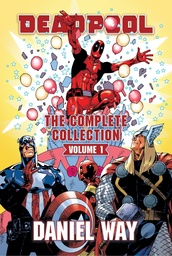
Vol. 1: The Modern Deadpool Machine Starts Moving
Deadpool by Daniel Way Omnibus Vol. 1 is the starting point for this particular version of Wade. The book establishes the tone: unstable narration, fast violence, constant verbal noise and a Deadpool who behaves as if every Marvel situation is secretly about him.
The strength of the first volume is momentum. It does not ask you to admire elegant construction first. It asks whether you enjoy being pulled through a loud superhero comedy where the lead character keeps turning danger into performance. For readers who like Deadpool as disruption, that is the appeal. For readers who need restraint, it can be exhausting.
Vol. 2: Bigger, Messier, More Franchise-Aware
Vol. 2 pushes the same identity further. By this point the question is no longer whether Deadpool can carry a book. The question is how much chaos the format can absorb before the joke becomes the world.
This is where the shelf becomes a collector decision. If Vol. 1 gives you the taste, Vol. 2 gives you the commitment. Together they are not a quiet character study; they are a portrait of Deadpool as a high-volume Marvel product that still depends on timing, absurdity and the reader's tolerance for excess.
Why The Run Matters
The run matters because it helps explain the Deadpool most casual readers now recognize: talkative, violent, self-aware, difficult to contain and built for collision. It is not the only valid Deadpool, but it is a major bridge between the cult character and the wider franchise version.
It also clarifies a useful collecting rule: popularity is not the same as universality. A famous Deadpool run can still be the wrong choice for a reader who wants tragedy, noir or tight plotting. This run is best judged by appetite. Do you want volume, speed and absurd Marvel interference? Then it has a clear job.
Who Should Buy It?
- Buy it if you want the loud modern Deadpool shelf and already know that his chaos is the point.
- Start cautiously if you like Deadpool but prefer sharper emotional stakes or cleaner plotting.
- Skip for now if you are building a minimal Marvel shelf and only want one definitive version of each character.
How It Fits On The Shelf
Place this run after you understand that Deadpool has more than one mode. Joe Kelly explains the cult foundation; later runs can give you a cleaner long-form evolution. Daniel Way gives you the loud middle point where Wade becomes easier to sell, easier to recognize and harder to contain.
The shelf works best when you do not ask it to be every Deadpool at once. Treat these volumes as the high-chaos franchise era. That makes their strengths clearer and their excess easier to accept.
Mistakes To Avoid
- Do not buy it only because Deadpool is famous; buy it because this specific noisy version appeals to you.
- Do not expect a restrained crime book or a tragic character study.
- Do not split the two volumes if your goal is to understand the Way era as a complete shelf.
Collector Verdict
For a Deadpool collector, Vol. 1 and Vol. 2 are not background extras. They document the moment when Wade becomes a bigger, noisier Marvel presence. The run is messy by design, but that mess is also its historical value. Buy it for the engine, not for elegance.

Comments
No comments yet. Be the first to share your thoughts.