Black Panther is a deceptively difficult omnibus shelf. The character has a clear iconography, but the collected editions move through very different ideas of Wakanda: Kirby invention, Don McGregor political adventure, Christopher Priest satire, Reginald Hudlin dynasty-building and Ta-Nehisi Coates' more philosophical nation story. The best first omnibus is not automatically the earliest one.
The useful question is what you want Black Panther to be on your shelf. If you want history, the early material matters. If you want the modern voice that reshaped T'Challa for later readers, Priest is the central entry point. If you want a broader Wakandan mythology, Hudlin and Coates push the line in different directions.
The early Marvel shelf: invention before focus
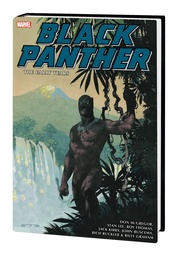
Black Panther: The Early Marvel Years Omnibus Vol. 1 is the historical foundation. It starts with T'Challa's first Marvel appearances, the Fantastic Four connection, Avengers material and the important Jungle Action stories that gave Black Panther a solo identity beyond guest-star status.
This material is valuable because it shows Black Panther being built piece by piece: Wakanda as a place, T'Challa as a king rather than just a superhero, and the Panther as a figure who does not fit neatly into standard Marvel street or team formulas. It also contains the older texture of Marvel comics, with denser narration and a different rhythm from modern runs.
Buy this first only if you enjoy origin shelves and historical context. For most readers, it works better after you already care about the character and want to see where the mythology came from.
McGregor and Panther's Prey: the political adventure shelf
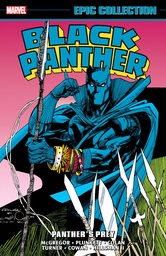
Black Panther: Panther's Prey Omnibus is the bridge between early Marvel appearances and the more mature idea of Black Panther as a political, geographic and moral adventure book. Don McGregor's work gives the character a seriousness that becomes important later: Wakanda is not just a backdrop, and T'Challa's decisions carry national weight.
This shelf is not the smoothest modern entry point, but it is one of the most important for understanding why Black Panther can support stories that are not only superhero fights. It treats land, monarchy, memory and violence as part of the character's world.
Christopher Priest: the best modern first purchase
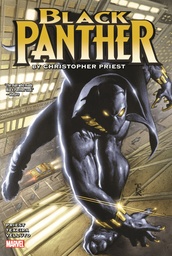
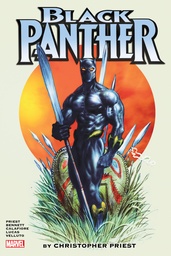
For many collectors, Black Panther by Christopher Priest Omnibus Vol. 1 is the real starting point. Priest does not simply modernize T'Challa; he changes the angle of view. Everett K. Ross becomes the reader's confused witness, while T'Challa stays several steps ahead of everyone around him.
The result is political satire, action thriller and character study at the same time. T'Challa feels dangerous because the book refuses to over-explain him. He is king, strategist, superhero and problem-solver, and the fun is watching the world underestimate him.
Priest Vol. 2 is the natural continuation rather than a separate entry point. If Vol. 1 works for you, Vol. 2 completes the shelf logic. If Priest's narration and satire do not click, buying around it will not fix the experience.
Reginald Hudlin: Wakanda as myth and dynasty
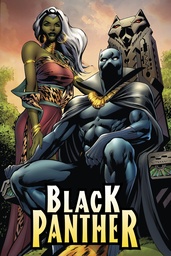
Black Panther by Reginald Hudlin Omnibus moves the shelf toward a broader, more direct mythology. Hudlin's run is easier to read as a statement about Wakanda, lineage, royal marriage and the Panther as a cultural icon. It is less slippery than Priest and more interested in making the character feel large and accessible.
This is a good second or third Black Panther purchase if you want the line to expand beyond the Priest voice. It also connects better with readers who came to the character through the wider modern visibility of Wakanda and want a run that treats the kingdom as a major part of the appeal.
Ta-Nehisi Coates and the modern nation story
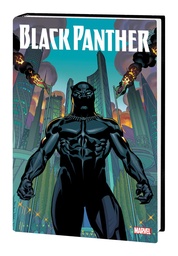
Black Panther by Ta-Nehisi Coates Omnibus is a different kind of shelf. It is slower, more political and more concerned with legitimacy, revolt, memory and what a king owes to a nation. This is not the punchiest first omnibus, but it has a distinct identity.
Coates is strongest for readers who want Black Panther to be about Wakanda as a political body, not just T'Challa as an action lead. If you want clean adventure, start with Priest or Hudlin. If you want a heavier modern argument about power, Coates earns its place.
Wakanda shelves and expansion books
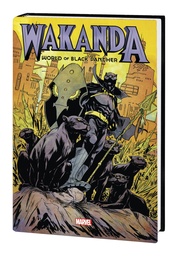
Wakanda: World of Black Panther Omnibus is not the first Black Panther book to buy. It is an expansion shelf: Shuri, supporting characters, kingdom mythology and related material that makes more sense once the central T'Challa runs are already placed.
That distinction matters. A strong Black Panther collection should not start with every Wakanda-adjacent volume. Build the T'Challa spine first, then decide how much of the wider world you want.
Recommendations by Reader Type
A quick way to choose the right Black Panther shelf depending on whether you want the best modern start, early history, dynasty, nation-building or Wakanda expansion.
The modern political thrillerChristopher Priest Vol. 1
The strongest gateway: sharp structure, Wakanda as political force and T’Challa as strategist.
Before the definitive shapeEarly Marvel Years Vol. 1
Best if you want the historical Marvel roots before later creators fully define Wakanda.
The McGregor routePanther’s Prey
A key bridge for readers who want the richer adventure and political texture before Priest.
Wakanda expands outwardReginald Hudlin
A strong shelf for Wakanda as dynasty, myth and broader Marvel presence.
Empire, faith and statehoodTa-Nehisi Coates
A slower modern route focused on Wakanda as a nation under pressure.
The best first Black Panther omnibus is Christopher Priest Vol. 1. Use Early Marvel Years for history, Panther’s Prey as the political-adventure bridge, Hudlin for dynasty and Coates for the modern nation story.
Comments
No comments yet. Be the first to share your thoughts.